
Batteries are still an essential element of the global energy system in the form of battery energy storage systems: BESS.
Photovoltaic systems, from individual prosumer panels to large solar parks owned by electricity companies, are some of the most natural users of BESS. For this reason, solar panel suppliers very often offer commercial packages that already include storage batteries.
In the vast majority of cases, lithium-ion batteries are used: they are more cost-effective than alternatives (such as lead-acid batteries), mainly due to their significantly better cost, efficiency, and lifespan ratio.
The size of the BESS naturally depends on the size of the solar plant to which it is connected; generally, one with a power rating 50-100% higher than the theoretical maximum power that the photovoltaic system is capable of delivering is chosen.
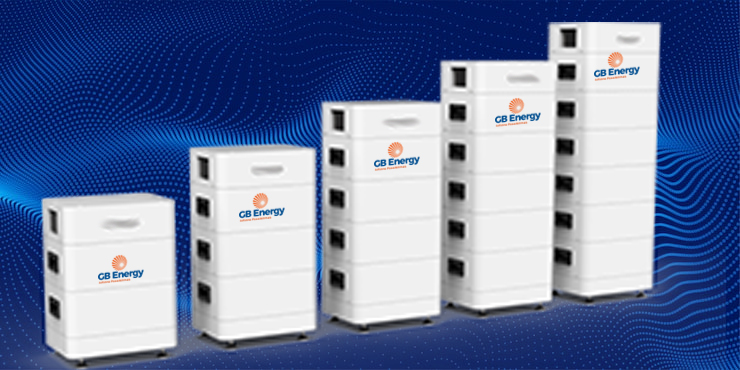
BESS are systems in which batteries, either individually or more often in groups, are used in order to store electricity produced by generation plants, and make it available when needed.
In a battery energy storage system, the fundamental components are the battery blocks, but there are also other elements: an inverter, which converts the direct current from the batteries into the alternating current of the electricity grid (and vice versa); a transformer, which adapts the system’s voltage to that of the grid; and finally, auxiliary systems (in particular cooling and fire protection).
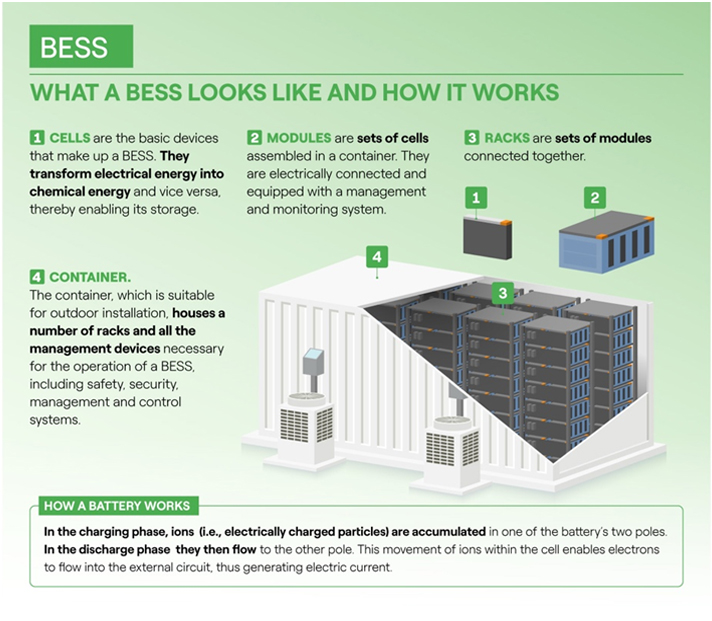
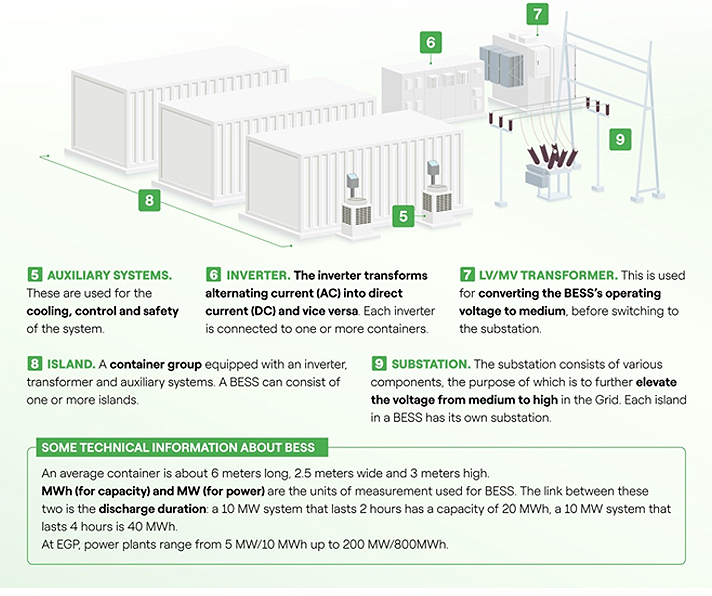
BESS technology is based on the use of electrochemical batteries, which can store the energy produced by renewable energy plants. They are a kind of power bank that can return the stored energy on demand.
BESS are one of the main energy storage systems.
They are also known as electrochemical energy systems. This is in order to distinguish them from others, such as gravitational energy systems (including pumped hydroelectric power plants), mechanical energy systems (including compressed air or flywheel systems), and thermal energy systems (Thermal Energy Storage, TES).
As in all storage systems, in BESS, the electricity produced by a power plant or any other generation method – even a single photovoltaic panel – is stored and then released at the desired times and moments. The specificity of BESS lies in the technique used for storage: since electric current is a flow of electrical charges, a battery is charged by accumulating the charges of particular materials (called electrolytes) in one of the two poles, from which they then flow to the other pole during the discharge phase.
The most natural users of BESS are electricity companies that have wind and solar power plants. In this case, BESS are generally large, are built near the main nodes of the transmission grid or are installed directly at the power generation plants.
However, there are many other possible applications, which are becoming increasingly widespread. Their growth is constant and is also linked to the phenomenon of prosumers (a combination of producer + consumer), i.e., self-producers of electricity: if, for example, a private individual has a solar panel on their home, a small BESS enables them to store the excess electricity produced during the day for use at night. It also ensures a certain degree of autonomy in the event of a blackout and the possibility of disconnecting from the electricity grid.
For industries and commercial companies, a BESS offers similar advantages but with greater flexibility: a company, especially if it’s energy-intensive, can regulate the amount of electricity drawn from the grid, for example to reduce it at times when prices are higher, or in general to avoid consumption peaks. Furthermore, a company can decide in advance to reduce consumption at times of peak demand: this not only ensures greater energy security, but can also contribute to grid stability while ensuring a financial return, thanks to the Demand Response mechanism.
BESS are also essential elements for microgrids, small electrical grids used for producing and distributing energy locally (e.g., large factories, industrial districts, or residential complexes).
Finally, BESS are functional for smart grids because they enable them to draw on a reserve if and when there is immediate need.